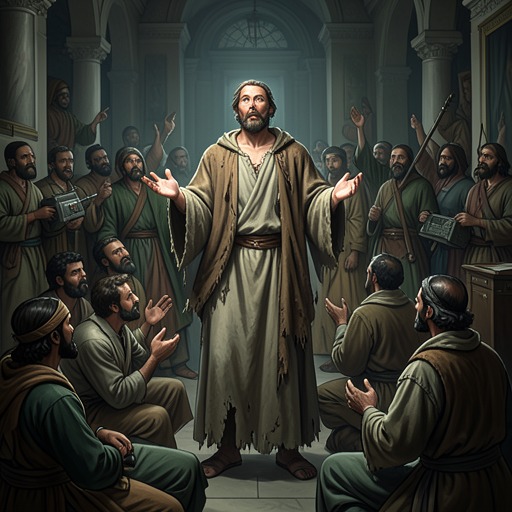
Jericho
Don't Leave God Alone: How to Get God's Attention, Remain in His Presence, and Even Change His Mind to Make a Difference in Your WorldJericho is presented as the third stage in Elisha’s progression with Elijah from Gilgal to Bethel, Jericho, and finally the Jordan. Its decisive significance lies in what it represents: the place where resistance is confronted, spiritual strength is developed, bondage is broken, and the power of God is demonstrated rather than merely discussed.
Setting in Elisha’s Testing Path
Elisha’s journey through Gilgal, Bethel, Jericho, and the Jordan is treated as a sequence of tests that formed his heart and commitment before he inherited Elijah’s mantle and ministry. Each location embodied a different demand upon the aspiring prophet. Gilgal represented new beginnings, consecration, and the removal of old fleshly habits; Bethel represented personal maturity, dependence upon God, and prayer when no human support was available. Jericho followed these preparatory stages as the place where commitment had to withstand direct opposition.
The book therefore places Jericho within a deliberate movement from inward dedication toward active spiritual conflict. Elisha needed more than a desire for divine power or a private relationship with God. He had to become the kind of person who would continue pursuing that power when circumstances resisted him and when the desired result did not appear immediately. Jericho was the testing ground in which persistence became active resistance.
Battle, Resistance, and Victory
Jericho is identified as the place where God first gave Israel victory in the land of Canaan. Its intimidating walls symbolize obstacles that appear solid, organized, and beyond ordinary human strength, yet are broken down through divine intervention. In this framework, Jericho becomes the biblical pattern for confronting resistance rather than retreating from it.
For Elisha, arriving at Jericho meant learning how to deal with opposition if he was going to walk in God’s power. The location is described as a place of battle and victory, where the powers of darkness are confronted and divine power is demonstrated. The emphasis is not on passive endurance. Jericho requires the believer to become strong in the spirit, to face resistance directly, and to operate in the anointing rather than allowing intimidation to define the outcome.
The book connects this overcoming spirit with David’s earlier training. David was able to confront Goliath because he had already learned to defeat a lion and a bear. Those animals are interpreted as two forms of conflict: the lion represents an outward attack that appears suddenly and threatens to consume, while the bear represents an inward struggle that may disappear for a season and then return with renewed hunger. David’s prior victories gave him confidence that the larger confrontation could also be met. Jericho thus signifies the repeated formation of courage through smaller and larger battles until resistance no longer determines a person’s expectations.
Deliverance from Recurring Bondage
Jericho also signifies deliverance. The book distinguishes genuine freedom from merely suppressing a problem. The bear’s pattern of feeding, hiding, and reappearing supplies an image for inward battles that seem absent for a time but return in a later season. A difficulty that has only been restrained has not necessarily been overcome; the recurrence itself reveals that deeper deliverance is still needed.
Within this interpretation, the believer must remain in the Jericho process long enough to confront the darkness that binds the inner life. The goal is not simply to survive a crisis but to become free from the spiritual forces and habits that repeatedly reclaim ground. Jericho therefore joins external victory to internal transformation: the walls outside must fall, but the recurring enemy within must also be defeated.
The lion supplies the contrasting image of visible, immediate opposition. Its roar is meant to create a sense of powerlessness before the attack arrives. Yet once a person learns to wield spiritual weapons and rise in the anointing, the enemy’s threat loses its final authority. Jericho teaches that divine power is learned through use. It becomes recognizable not in abstraction but in the act of confronting what seeks to destroy or intimidate.
Persistence as the Measure of Power
The larger argument surrounding Jericho treats persistence as the condition through which miracles and deliverance become possible. The book repeatedly contrasts those who refuse to leave God alone with those who withdraw too soon. Moses continued pleading when God declared that Israel had corrupted itself through the golden calf, and his intercession resulted in mercy rather than national destruction. Jacob refused to release God until he received a blessing. Hezekiah prayed after being told that he would die and received an additional fifteen years. Elijah prayed earnestly for the rain to stop, and the land experienced drought for three and a half years.
Jericho gathers these examples into a single spiritual principle. The believer’s authority is tested when the answer is delayed, when resistance appears stronger than faith, or when an old struggle returns. The same principle is applied to personal crises in the book’s modern testimonies. A newborn girl with an incurable disease affecting her liver and blood was given only an 11 percent chance of survival, yet the church continued praying and speaking God’s promises even as the child’s condition worsened. The family and congregation reached a point of determination in which fear and shock were set aside, and they refused to accept the apparent direction of events.
Jericho also illuminates the book’s teaching about dreams that seem to be dying. The Lazarus story is used to urge believers not to surrender when bad news, delay, or visible deterioration appears to imprison a promise. The enemy’s pitfalls are said to include negative reports that provoke premature defeat. In this pattern, Jericho is the stage at which the believer answers adverse evidence with continued pursuit, just as the walls of the city represent a barrier that must not be mistaken for the final word.
Narrative and Thematic Significance
As a location, Jericho functions simultaneously as historical setting, spiritual metaphor, and threshold in Elisha’s formation. The city’s biblical association with broken walls gives the book an image for the collapse of resistance, while its placement between Bethel and the Jordan marks a transition from dependence and maturity toward the full inheritance of prophetic power. Elisha does not reach the Jordan as an untested follower; he arrives after passing through a sequence designed to make him unwilling to let go of God’s power.
Jericho’s meaning is also defined by contrast. Gilgal removes the old and establishes commitment; Bethel teaches the believer to rely upon God alone; Jericho confronts the enemy; the Jordan stands beyond it as the next stage of passage and power. The location thus turns spiritual growth into a mapped journey. Each place asks a different question, and Jericho asks whether faith can remain active when it meets resistance.
The book’s first-person testimonies give this symbolic geography practical force. A late-night interstate collision, a comatose elderly relative believed to be near death, the critically ill newborn, a family member suffering septic shock and multiple organ failure, and a neighbor who survived a fall from a bridge are all presented as situations in which established pursuit of God mattered. These accounts are not described as Jericho events in a literal geographical sense, but they extend Jericho’s logic into contemporary life: crisis exposes whether prayer has been cultivated, and persistent prayer is portrayed as the means by which believers confront danger, seek deliverance, and expect divine intervention.